- Retailers are consolidating their technological transformation, although challenges in advanced innovation remain, according to the 3rd edition of the Beroni Barometer on Innovation in Travel Agencies, conducted by ObservaTUR
- By 2026, retailers will prioritize automation and customer management in their investments; staff training will take a back seat, but it will remain the largest area of investment.
May 12, 2026.— Travel agencies continue to make progress in their technological transformation, according to the third edition of the Beroni Barometer on Innovation in Travel Agencies, conducted by ObservaTUR for this company specializing in technology for the tourism sector.
The results show that most professionals perceive a positive trend, particularly in areas related to digitalization, automation, and technological adaptation.
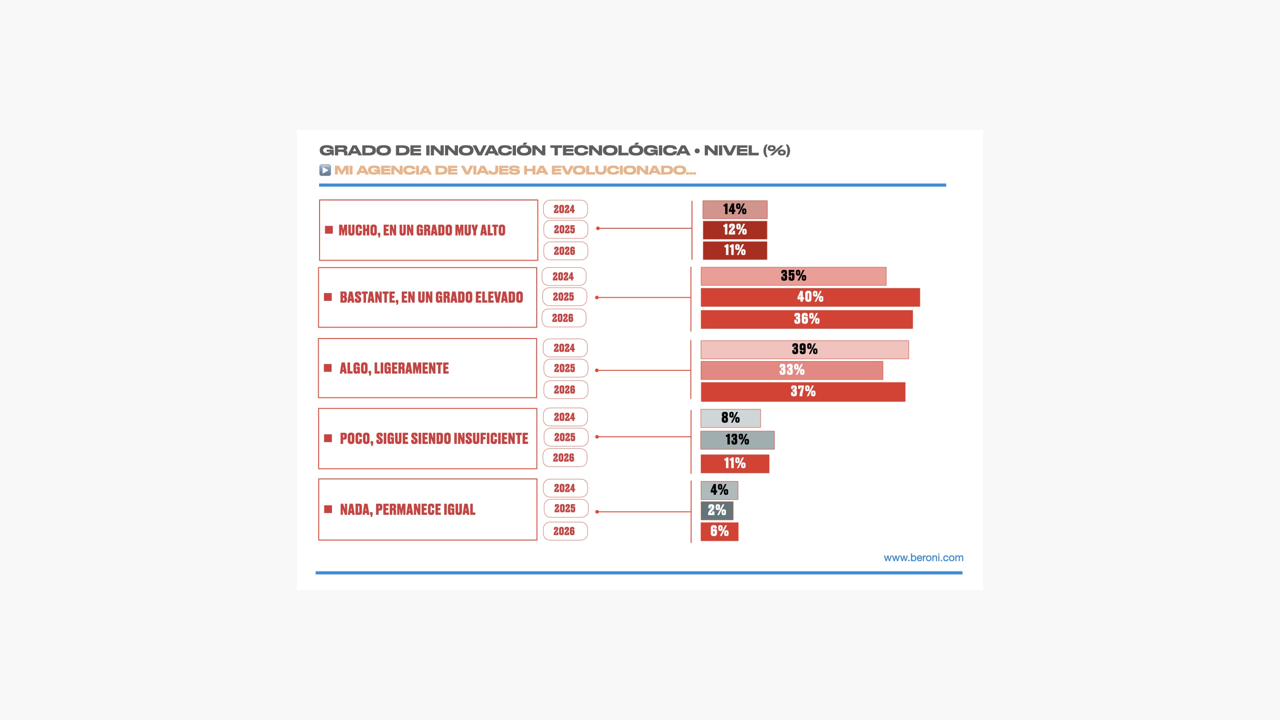
According to the data analyzed, nearly half of the sector believes that their agency has evolved “a lot” or “quite a bit” in terms of technology during the 2024–2026 period. The most prominent response falls into the “Quite a bit, to a high degree” category, which peaks in 2025 with 40% of responses.
However, the study also reveals a certain degree of moderation in expectations regarding cutting-edge innovation. The perception of “very high” growth declines gradually from 14% in 2024 to 11% in 2026, which could be interpreted as either higher expectations from the sector or a slowdown in the adoption of truly disruptive technologies.
At the same time, a significant proportion of respondents believe that technological progress has increased “somewhat, slightly,” with percentages remaining stable at around one-third of the responses. This finding suggests that, while there is a consensus on digital progress, many agencies still see room for improvement in the depth and speed of the transformation.
Negative assessments remain in the minority. However, the growing number of respondents who view technological progress as insufficient in certain years highlights the increasing competitive pressure and the need to continue investing in innovation, AI, process automation, and the digital customer experience.
Overall, Beroni’s new Technology Barometer confirms that the travel agency sector continues to make positive strides in technology, although it faces the challenge of accelerating innovation to respond to an increasingly digital and competitive tourism environment.
- Travel agencies are prioritizing automation and customer management in their investments through 2026.
Regarding forecasts for innovation investment in 2026, respondents believe that staff training remains the top priority, although its importance is expected to decline by 2026, dropping from 59% to 46%. This could be interpreted as an indication that the initial phase of training is already well underway or as a reallocation of resources toward more specific technological tools.
When it comes to marketing and advertising, these areas continue to rank second, although their share has also declined (from 49% to 41%). This data indicates that digital outreach and visibility remain strategic priorities, but with a potentially more optimized or selective approach.
Meanwhile, investment in websites and digital improvements will gain prominence in 2026, rising from 35% to 37%. This points to a growing focus on the online experience, digital conversion, and the adaptation of sales channels.
Management software (back-office and CRM), meanwhile, is showing some of the most significant growth, with the former rising from 16% to 24% and the latter, CRM, from 15% to 19%.
This trend suggests a growing professionalization of the sector and an increasing interest in automating processes, improving operational management, and enhancing customer insight.
Additional data for analysis:
- Hiring of new staff has dropped from 30% to 24%, which could indicate
a strategy focused more on technological efficiency and automation than on
expanding the workforce. - Investment in hardware remains relatively stable (18% to 20%), indicating that priorities are no longer focused as much on physical infrastructure as on digital solutions and software.
- The percentage of companies that do not plan to make any of these investments
has risen slightly from 10% to 12%, which could reflect economic prudence
or differences in the level of technological maturity among agencies.
Josep Bellés, CEO of Beroni: “The industry has come to realize that technology is no longer a differentiator, but rather an essential requirement for competing. Agencies are constantly evolving and are increasingly integrating digital tools designed to improve efficiency and the traveler experience. Furthermore, forecasts for 2026 point to a more digitally mature industry, where investment is beginning to shift from initial adaptation toward process optimization, automation, and intelligent customer management.”